What to Look for When Buying an Indoor Sauna in 2026
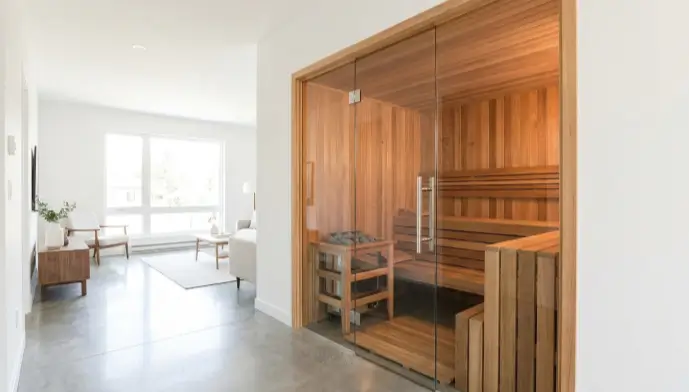
Buying an indoor sauna in 2026 comes down to five checks: heat type (electric traditional versus infrared), electrical requirements against what your home’s panel can actually support, wood species and panel construction, ventilation planning for the room the cabin sits in, and total installed cost rather than the unit’s sticker price. Skipping any one of these is the most common reason buyers end up with a cabin that runs hot in one corner, trips a breaker, or needs a room-sealing fix a year in.
Traditional Electric Heat or Infrared: Which Fits an Indoor Install?
A traditional electric heater warms the air to roughly 170 to 195 degrees Fahrenheit and typically needs a dedicated 240-volt circuit, which is straightforward in a basement or utility room close to the panel but can get expensive if the run is long. An infrared cabin heats the body more directly at a lower ambient temperature, usually 120 to 150 degrees, and many two-person models plug into a standard 120-volt, 20-amp outlet, which makes them a realistic option for a spare bedroom or a converted closet where adding 240-volt service is not practical. Neither is a wrong choice indoors; the deciding factor is usually what your electrical panel can support without an upgrade, plus which heat sensation you actually want.
Built-In Versus Prefab Cabin: What Changes for an Indoor Space?
A prefab cabin ships as a kit of pre-cut panels that bolt together in a few hours and can be relocated later if you move or remodel. A built-in sauna is framed and finished in place like any other room feature, which allows odd-shaped spaces to be used efficiently but commits the space permanently and generally costs more in labor. For most indoor installs in an existing home, a prefab cabin is the faster and cheaper route, while a built-in makes more sense during a larger basement or bathroom renovation where the framing is already open and an electrician and tile setter are already on site.
What Wood and Construction Details Actually Matter?
Western red cedar and Nordic spruce are the two materials that consistently perform well inside a heated, humid box without warping or releasing much resin once hot. Heat-treated hemlock is a common cost-saving substitute and holds up reasonably well when properly kiln-dried, though it should be named specifically on a product listing rather than described vaguely as “premium wood.” Tongue-and-groove panel joinery with no exposed metal fasteners on the interior is the standard for a reason: exposed screws heat up quickly and become an unpleasant surprise against skin, while loose-fitting boards leak heat and shorten the heater’s working life by forcing it to run longer for the same result.
How Much Clearance and Ventilation Does an Indoor Cabin Need?
Every heater has a published clearance spec, typically several inches from combustible surfaces on the sides and more above the stones, and an indoor install has to respect that even inside a finished room. The cabin itself needs a low intake vent and a higher exhaust vent to keep air circulating during a session, since a sealed box with no airflow gets stuffy and uneven in temperature. Just as important is the room around the cabin: a basement or interior room with poor general ventilation can accumulate humidity from sauna use over months, which is worth addressing with a vent fan or dehumidifier rather than ignoring until moisture shows up on nearby drywall or flooring.
See also: Improving Business Efficiency Through Professional Compliance Support
What Does an Indoor Sauna Cost Once Everything Is Added Up?
A compact plug-in infrared cabin for one or two people often lists between $2,000 and $3,500 with no electrical work required beyond a standard outlet. A traditional electric cabin sized for three or four people typically runs $4,000 to $7,500 for the unit, plus $500 to $1,500 for a dedicated circuit depending on distance from the panel, plus any flooring or moisture-barrier work the room needs first. Comparing listed prices across brands only tells part of the story, since two units at the same price point can differ substantially in heater wattage, wood species, and warranty length. It’s worth reading full spec sheets from a few retailers, including established names like Almost Heaven, Sunlighten, and others, before narrowing down; buyers who want to see options laid out by size and heat type can see the full lineup as one point of comparison.
What Warranty and Support Terms Are Worth Checking?
Warranty length is one of the fastest ways to tell a well-built cabin from a cheaper import, and it deserves as much attention as wood species or heater wattage. Look for at least two years on the heater element itself, with five or more years common among established brands that stand behind their build quality. Panel and structural warranties often run longer, sometimes a decade or more, since the wood and joinery are less likely to fail than an electrical component. A listing that does not state warranty terms clearly, or buries them behind a support ticket rather than on the product page, is worth treating as a signal to look elsewhere. It is also worth asking directly whether replacement parts, stones, gaskets, and bench boards among them, are stocked and sold individually, since a cabin that requires a full unit replacement for a worn gasket is a more expensive long-term ownership proposition than one with an active parts program.
What Do Independent Reviews of Sauna Bathing Actually Support?
A number of independent reviews have looked at what regular sauna bathing is associated with, separate from any single brand’s marketing claims. A 2018 review in Mayo Clinic Proceedings summarized cardiovascular and other health associations reported across multiple studies of Finnish sauna users. A systematic review in Evidence-Based Complementary and Alternative Medicine reached broadly similar conclusions about regular dry sauna bathing, while an older but frequently cited review in The American Journal of Medicine covered both the reported benefits and the real risks and contraindications of sauna use, including for people with unstable cardiovascular conditions. These are consistent, reviewed associations rather than guarantees for any individual, and none of them substitute for asking a doctor about a specific health condition before starting regular sauna use.
Frequently Asked Questions
Is a plug-in indoor sauna as good as a hardwired one? A quality plug-in infrared cabin on a dedicated 120-volt circuit works well for one or two people, but will not match the temperature or recovery speed of a hardwired 240-volt traditional heater. Choose based on the heat style you want.
Do indoor saunas need special ventilation? Yes. The cabin needs a low intake vent and a high exhaust vent, and the surrounding room needs enough general ventilation to manage humidity over time.
How much floor space does a two-person indoor sauna need? Most two-person cabins have a footprint of roughly 4 by 4 feet to 4 by 6 feet, plus clearance for the door and heater service access.
What separates a budget indoor sauna from a well-built one? A named wood species and drying method, tongue-and-groove construction with no exposed interior fasteners, a heater with a stated wattage and at least a two-year warranty, and clearly published clearance and electrical requirements.
References
- Cardiovascular and Other Health Benefits of Sauna Bathing: A Review of the Evidence, Mayo Clinic Proceedings, 2018
- Clinical Effects of Regular Dry Sauna Bathing: A Systematic Review, Evidence-Based Complementary and Alternative Medicine, 2018
- Benefits and risks of sauna bathing, The American Journal of Medicine, 2001
By Trevor Adams